Many Australian holidays are different from those in the United States. It seems strange to American visitors that while religious holidays occur on the same dates, the seasons are reversed. For example, Christmas takes place in the summertime on December 25. Australian national public holidays are listed below:
New Year's Day
Australians celebrate the New Year's Day holiday on January 1 the same way Americans do. People stay up late on December 31 with family and friends. They welcome the new year with a countdown, food and drinks. Many sing Olde Lang Syne when the clock strikes midnight.
Australia Day
Australia's national day is on Australia Day, January 26. This marks the date in 1788 that Europeans first settled in Australia. Captain Arthur Phillip, of the British Royal Navy, sailed into Port Jackson (Sydney Cove) with 11 ships full of convicts and guards. He established the first penal colony on a site that is now in downtown Sydney, Australia's largest city.
 Fun Fact: Howdy Pilgrim
Australians do not celebrate Halloween or Thanksgiving. Valentine's Day and St. Patrick's Day are not as important as in the US. |
Anzac Day
Australians celebrate Anzac Day on April 25. On that day in 1915, troops from the Australia and New Zealand Army Corps (ANZAC) landed in Gallipoli, Turkey to fight in World War I. It was the first time that the Australians had fought under their own flag, not Great Britain's. Thousands of soldiers were killed or wounded in the eight months of terrible battle. Finally they were forced to leave. Word soon spread of their courage under impossible conditions. Much of Australia's sense of pride stems from this period in history.
Today, veterans get together with serving soldiers before sunrise for a "gunfire breakfast" of coffee and rum. Thousands of Australians gather for outdoor dawn services to honor all soldiers who have died in war since the First World War. Many attend military parades in cities and towns later in the morning. Afterwards, veterans and soldiers enjoy a betting game, Two-Up, traditionally played only on Anzac Day each year.
Good Friday, Easter and
Easter Monday
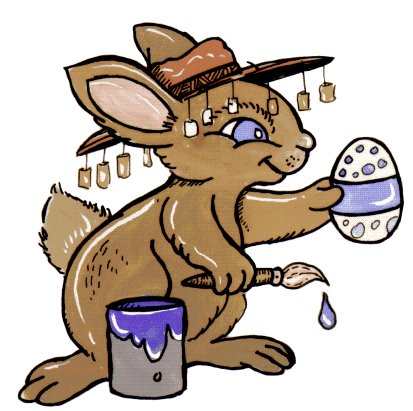
Christians celebrate the religious holiday of Easter with church services, hot cross buns, Easter baskets and egg hunts. Good Friday and Easter Monday are also public holidays. They take place in March or April, the autumn in Australia. People do not associate Easter with spring flowers, as they do in the United States.
Queen's Birthday
The Queen's Birthday holiday honors the birth of Elizabeth II, Queen of Australia. Her birthday is actually in April. People have observed this holiday on the second Monday in June since the reign of the British King George V, whose birthday was in June. It is commemorative only. It has no special traditions in Australia.
Christmas
Christmas takes place on December 25, the summertime in Australia. People often spend part of Christmas day with their families at the beach. Christmas dinner is just as likely to be salads, cold meat and seafood as the traditional meal of roast turkey and plum pudding. Children believe that Santa Claus leaves presents for them under the Christmas tree on Christmas Eve. One popular Australian song states that six white boomers, or large kangaroos, pull Santa's sleigh.
Boxing Day
Australians celebrate Boxing Day, a British holiday, on December 26. In the past, wealthy families required their servants to work on Christmas Day. As payment, they allowed the servants to celebrate the following day. They gave them boxed gifts, usually of money, to thank them for their service. The churches also distributed money from poor boxes on Boxing Day. These days everyone enjoys an extra day off in the summer. Outdoor events, especially sports, are a favorite past-time. Australia's biggest yacht race begins on Boxing Day. The yachts sail more than 600 miles from Sydney, NSW to Hobart, TAS. Thousands of spectators relax in sailboats on Sydney Harbour to watch the start of the race.
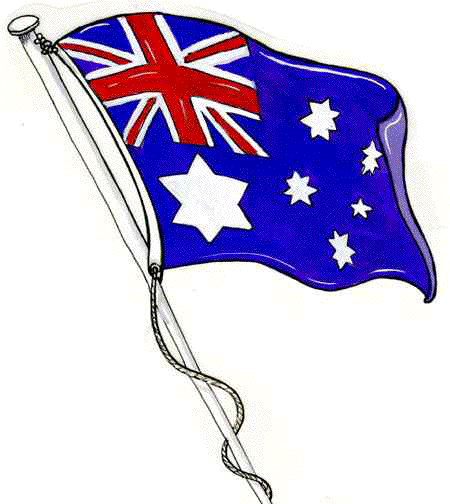
The Australian flag is made up of three distinct parts: the Southern Cross, the Commonwealth Star and the Union Jack. The background of the flag is blue. On the right-hand side are the five white stars that make up the Southern Cross constellation as seen in the skies of the Southern Hemisphere. Four of the stars have seven points, and one has five.
The large white star in the bottom left-hand corner has seven points, one for each of the six states and one for the territories. This symbolic star is called the Commonwealth Star.
In the upper left-hand corner is the Union Jack, Great Britain's flag. Australia has kept the Union Jack in its flag as a reminder of where many of the early settlers came from and because Australia is a member of the British Commonwealth.
Australia is also represented by a coat of arms, which contains a red kangaroo, an emu and some golden wattle blossoms. These symbols are widely accepted as Australia's national animal, bird and flower. The Commonwealth Star is on top. The coat of arms also has a shield which displays each of the state's emblems.
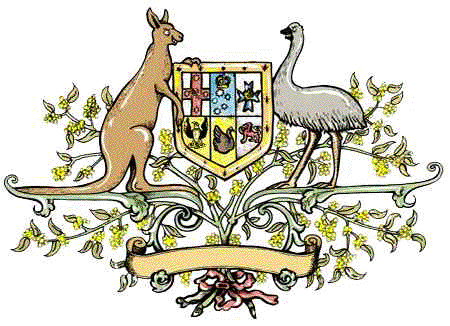
The coat of arms is used by the Commonwealth of Australia to identify its authority and property. It belongs to the Common-wealth, and in general, is for official use only.
Decimal currency was introduced in Australia in 1966, replacing pounds, shillings and pence. The major unit is called the Australian dollar, made up of 100 cents. In January 1994, $1.00 in Australian currency equaled approximately 77¢ in American money. This is called the exchange rate, and it changes from day to day.
Australian coins are minted with these values: 5¢, 10¢, 20¢, 50¢, $1 and $2. Originally there were 1¢ and 2¢ coins, but these are no longer made. Australians do not have special names for their coins, as Americans do. For example, the 5¢ coin is not a nickel, but simply a 5-cent piece. All coins have a likeness of the queen on the front. The reverse side of each coin depicts animals unique to Australia, except for the $2 piece, which shows an Aboriginal elder.
Coin Value Image on Reverse Side
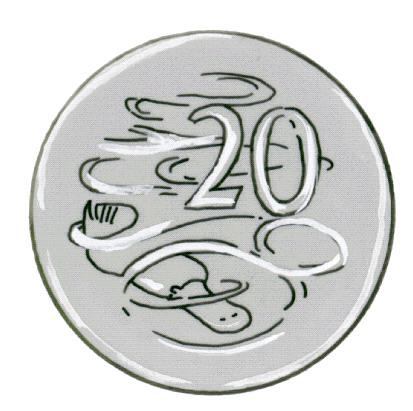
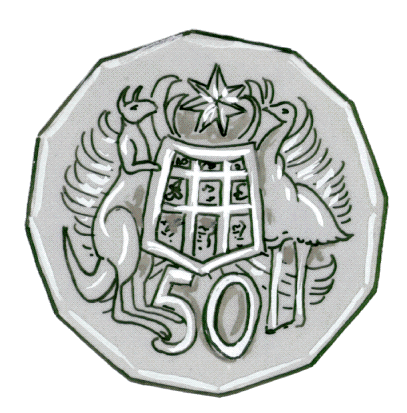
5¢ Echidna 10¢ Lyrebird 20¢ Platypus50¢ Kangaroo and emu
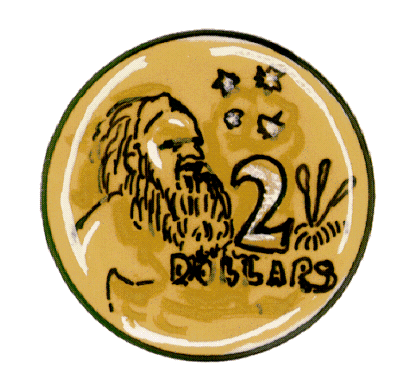
$1 5 kangaroos$2 Aborigine
Bills are printed in five, ten, 20, 50 and 100 dollar values. Australians call them notes. Each note is a different size and color, with the lower values being smaller in size. Each depict personalities or themes of Australian historical interest. The $5, $10 and $20 notes are now printed on a plastic material called polymer, with lots of colors and a hologram to prevent counterfeiting. These notes last longer than the previous paper ones because they are harder to tear or wrinkle.
Australia's stamps are unique and colorful. Among other things, they feature themes from Australia's natural environment. They also showcase famous Australians.
Australian Catalogue Company
7412 Wingfoot Drive
Raleigh, NC 27615
Tel: (919) 878-8266
Fax: (919) 878-0553
Kangaroo Connection:
The Australian & New Zealand General Store
1113 W. Webster Avenue
Chicago, IL 60614
Tel: (773) 248-5499
International Specialised Book Service
5602 NE Hassalo Street
Portland, OR 77213-3640
Tel: (503) 257-3093
Fax: (503) 280-8832
Art and Australia Magazine
(Plus books on Australian art)
International Publications Distributor
820 Town Center Drive
Langhorne, PA 19047
Tel: (215) 750-2642
Fax: (215) 750-6343
Austral Gallery
2115 Park Avenue
St. Louis, MO 63104-2539
Tel: (314) 776-0300
Australia Stamp Agency in North America
1 Unicover Center
Cheyenne, WY 82008-0010
Tel: (307) 771-3000
Fax: (307) 771-3134
Other publication and stamp companies may exist which are not listed here. Please write to the embassy (address on title page) to include other firms in the next edition of this document.
 HOLIDAYS