 Tell Me About:
  Tell Me About:
In some ways, Australia and the United States have similar histories. The two countries are good friends, and the people generally like each other. This is partly because the modern histories of both began when they were colonies of Great Britain. However, each developed in its own way. The American colonies fought for independence from Great Britain in the Revolutionary War. They began the process with their Declaration of Independence in 1776. The Australian states federated (joined together) in 1901 through a peacefully negotiated settlement with the British government.
First Settlers
Australia's original inhabitants were the Aboriginal and Torres Strait Islander peoples. The Aborigines migrated from southern Asia, and began living in Australia about 50,000-60,000 years ago. This is about the same time Native Americans traveled from northern Asia to North America. Some archeologists believe that the migrations may have occurred as long as 100,000 years ago. Other early immigrants, the Torres Strait Islanders, arrived about 10,000 years ago.
Searching for terra australis incognita (the unknown southern
land) was a great challenge for European navigators in the 17th and 18th
centuries. Several of them passed by parts of the Australian coastline without
realizing how it fit into the puzzle of world geography. The first was Spanish navigator Luis Vaez de Torres in 1606. In 1770 a British explorer,
Captain James Cook, sighted the east coast of Australia and claimed it for
Great Britain. After the British lost their American colonies, they were
unable to transport convicts to settlements in Virginia, Maryland and Georgia.
Britain decided in 1787 to send some of its convicts to Australia.
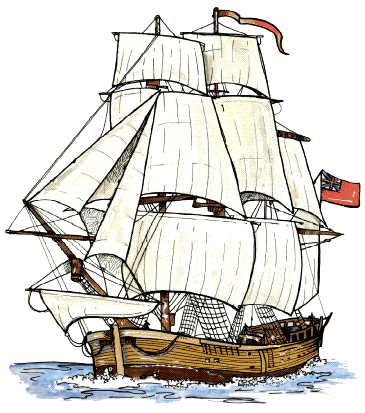
In 1788 the first fleet of 11 ships arrived in Australia at Port Jackson, later known as Sydney. There were 1530 passengers. Over 700 were convicts. The remainder were soldiers sent to guard them and make them work.
Early Economy
Free settlers also arrived from Great Britain to take advantage of the colonial government's offers of low-cost land and supplies. The British government had hoped that the settlers would be self-sufficient in food within two years. The early years were hard. The settlers faced poor soil, droughts and isolation. They also had problems with Aborigines, who were upset that colonists had fenced their land. The first settlers almost starved. They had to depend heavily on Great Britain for supplies of food, clothing and equipment for a number of years.
Some settlers introduced merino sheep from Spain in 1797. They had hoped to find an agricultural product that would do well in Australia's dry climate. They also wanted to provide income for themselves. Through careful breeding, the merinos soon began to grow some of the finest wool in the world. They still do today.
 Fun Fact: Tracing Back to #1
Some Australians today are descendants of the "First Fleeters" - Australia's first settlers. They are proud of their heritage, just like US descendants of the Mayflower passengers. |
New Settlements
As the colony grew, so did the need to find new land. From the early 1800s, explorers trekked and mapped the unknown parts of Australia. New settlements followed in Hobart, Brisbane, Melbourne, Perth and Adelaide. These cities became the capital cities of new colonies.
Gold Rush
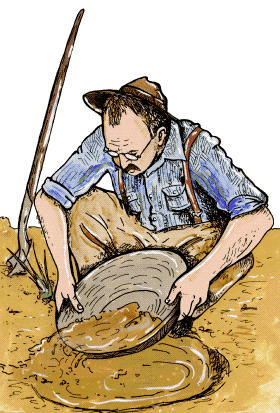
Australian miners discovered gold in 1851. Fortune
hunters arrived from many parts of the world, including California. About
95,000 people migrated to Australia the following year. This coincided with
the transportation of Britain's last group of convicts. Australia soon followed
the example of the American West. Order and steady progress gave way to
desperation and lawlessness.
The way Australian bush towns sprang up during the Gold Rush era was similar to the development of the western United States. Distances were great and few roads existed. John Cobb arrived in Melbourne from San Francisco and started the Cobb and Co. Coach Line. Like Wells Fargo in the United States, it made transportation and communication quicker and more efficient. It also made the development of new settlements easier.
Nationalism
A common feeling of being Australian, rather than British, was developing among the colonists. Great Britain also had difficulty administering colonies so far away. These issues convinced the British government that Australians were ready for self-government.
Great Britain granted the colonies self-government in the mid-1800s. Each of the colonies soon became states when they formed their own elected legislative councils and wrote constitutions.
After almost 10 years of debate in both Great Britain and the Australian states, the British parliament finally passed the Australian Constitution into law in 1900. On January 1, 1901, the six states federated to become a new nation, called the Commonwealth of Australia.
Before federation there was much debate about where the new nation's capital should be. Both Melbourne and Sydney were growing cities. A compromise was reached in the constitution to locate the capital in New South Wales, but it had to be at least 100 miles from Sydney. A long search for a site led to former sheep grazing country in the highlands between Sydney and Melbourne. The Australian Capital Territory was carved out of New South Wales in 1911 . The new capital city was called Canberra, an Aboriginal word meaning "meeting place." The capital was finally moved from Melbourne in 1927.
Fun Fact: That's a "Capital"
IdeaAn American architect, Walter Burley Griffin, won a competition to design the layout of Canberra |
The 20th Century
Australian soldiers joined troops from other nations to fight in the First and Second World Wars (1914-1918 and 1939-1945). A combined total of 90,000 Australians died in these conflicts, and people around the world noted their bravery. Australians came to be proud of the sacrifices that all had made towards the cause of democracy. Because it was such a young nation, these experiences helped them to form their unique Australian identity.
Like Americans, Australians also suffered through the Great Depression from 1929 to the late 1930s. About one-third of the workforce was unemployed. There was widespread hunger and homelessness. The Australian economy began to recover during World War II as factories increased production for the military war effort.
In 1949, Australians embarked on an ambitious project to create more electricity and jobs. They called it the Snowy Mountains Hydroelectric Scheme. Construction workers and their families soon arrived from overseas to work on this project. Other immigrants, mainly Europeans, moved to Australia after World War II to escape the hardships caused by the war. Australian industries began to thrive by producing housing, goods and services for the large numbers of newly arrived immigrants.
Australian soldiers fought in one other war that had a major impact this century. They were sent to Vietnam from 1965 to 1973. Australian troops also have participated in many of the United Nations' peacekeeping efforts, helping to restore order to war-torn countries, including Korea and Cambodia.
In the last decade of the 20th century, Australia is a country of peace and prosperity. Australia's standard of living is among the highest in the world. People all over the world recognize and value Australian culture and technology. Almost a century after federation, Australia continues to grow as a nation and find its place in the world.
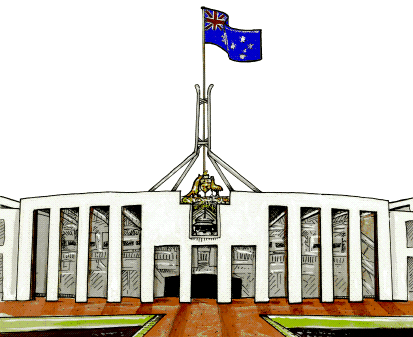 Australia is a parliamentary democracy. At the
federal level, it has two houses of parliament, the House of Representatives
and the Senate. They were named after the two houses in the United States
Congress. The country also has state and local levels of government.
Australia is a parliamentary democracy. At the
federal level, it has two houses of parliament, the House of Representatives
and the Senate. They were named after the two houses in the United States
Congress. The country also has state and local levels of government.
The Australian head of government is the prime minister. The prime minister is the leader of the party that holds the most seats in the House of Representatives.
Australia's head of state is Queen Elizabeth II, the ruler of Great Britain. She also holds the title, Queen of Australia. An appointed governor-general represents the queen in Australia and normally plays a ceremonial role in government.
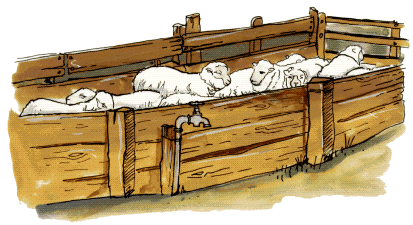
Agriculture is very important to the Australian economy. With more than 150 million sheep, Australia is the world's largest wool producer. The country supplies 70% of the wool that factories in other countries use to make clothing. Australia is also a large supplier of meat, dairy products, cereals, fruit, vegetables and sugar.
 Australia is rich in many energy resources and
minerals. The country exports uranium, light crude oil and liquefied gas.
Australia is the world's largest exporter of coal and diamonds. Australian
mining industries are also major producers of bauxite, mineral sands, gold,
lead, zinc, iron, copper, nickel and manganese.
Australia is rich in many energy resources and
minerals. The country exports uranium, light crude oil and liquefied gas.
Australia is the world's largest exporter of coal and diamonds. Australian
mining industries are also major producers of bauxite, mineral sands, gold,
lead, zinc, iron, copper, nickel and manganese.
Australians make many products for use in Australia and for export. They produce chemicals, plastics, electronics parts, processed food, ships, motor vehicles, and steel and aluminum products. They also are innovators in aerospace technology, medical science, computers and engineering.
Australia exports more than one-fifth of everything it produces, mostly to Asia. Japan buys almost a quarter of Australia's total exports. The United States is Australia's largest source of imports. More than one-fifth of Australian imports come from the US.
US |
AUSTRALIA | |
| Earliest Immigrants | 60,000 years ago - |
60,000 years ago - |
| European Explorers | Spanish, British, Dutch, French |
Dutch, Brisith, Portugese, French |
| First Settlement | 1565 - St. Augustine FL 1606 - Jamestown, VA |
1788 - Sydney, NSW |
| States Originally Settled as Penal Colonies | Virginia, Maryland, Georgia |
New South Wales, Tasmania, Queensland |
| Birth of the Nation | 1776 - Proclamation of the Declaration of Independence |
1901 - Federation of the six states |
| Number of States at Birth | 13 |
6 |
| Number of States in 1995 | 50 |
6 |
| Move to New Federal Capital | 1800 - Washington, DC |
1927 - Canberra, ACT |
| Gold Rush | 1848 - Sutter's Mill, CA |
1851 - Bathurst, NSW |
| Closest Neighbors | Canada, Mexico |
Indonesia, Papua New Guinea |
| Land Area | 3.63 million square miles |
2.97 million square miles |
| Population Estimate | 265 million people |
18 million |
 HISTORICAL
BACKGROUND
HISTORICAL
BACKGROUND