 Tell Me About:
  Tell Me About:
 Australia is the world's largest island and its smallest continent. It is also the only continent made up of a single country. People sometimes call Australia the "Land Down Under" because it lies entirely in the Southern Hemisphere, down under the equator. The Tropic of Capricorn runs through the northern part of the country. Australia is located between the Indian and the Pacific Oceans. Its nearest neighbors are the countries of Indonesia and Papua New Guinea.
Australia is the sixth largest country in the world at 2.97 million square miles. That is almost the same size as the United States without Alaska or Hawaii. It was one of the earliest lands formed on earth.
Nature has had time to wear down mountains and fill up valleys. Australia is thus the lowest and flattest of the continents. More than 90% of its surface is lower than 2000 feet above sea level. Australia has also been separated from other continents for millions of years. This is why its animals and plants are so different.
 Fun Fact: Official Name
Australia's official name is the Commonwealth of Australia. It comes from the Latin words "terra australis incognita" meaning "unknown southern land". Matthew Flinders, an Australian explorer, first used the name "Australia" in 1814 in a book about his journeys. |
 TOPOGRAPHY
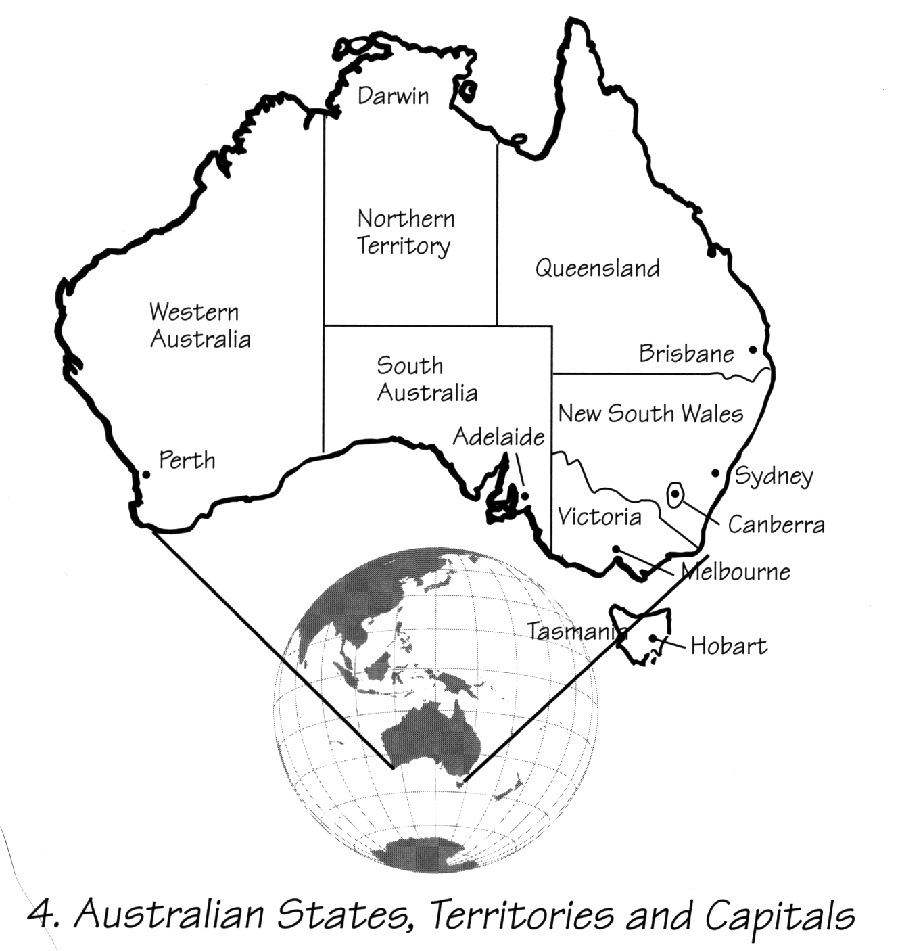
Geographers divide Australia into four main land areas: the Coastal Plain, the Eastern Highlands, the Central-Eastern Lowlands and the Great Western Plateau (see map 2). The Coastal Plain is a strip of land down the eastern coast, around the southeast corner of the continent, and in the southwest. It ranges from lush tropical areas to drier sandy plains. It is relatively well-watered. Because of the warm, moist climate and rich farmland, this is where most Australians live (see map 3).
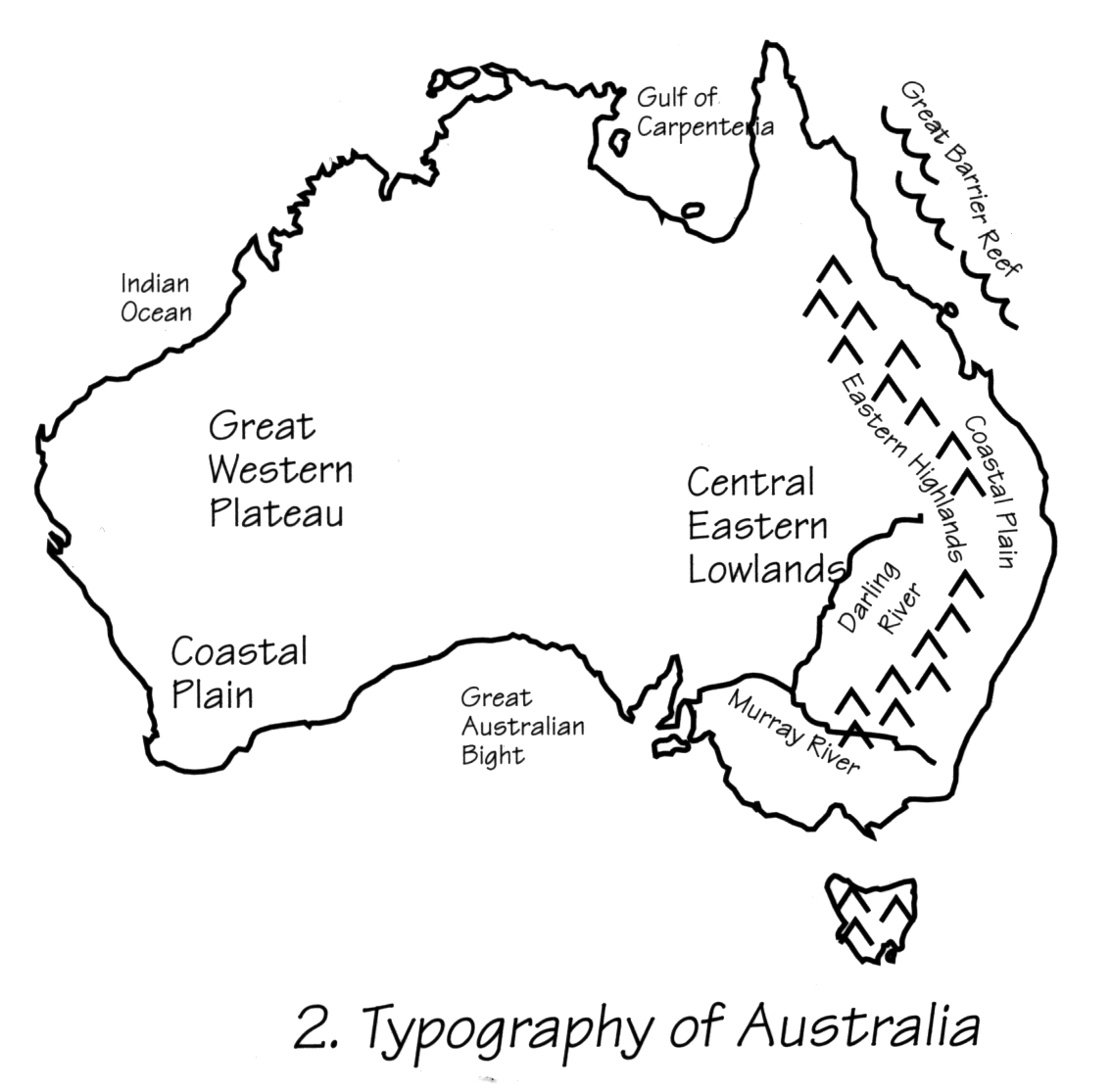

The Eastern Highlands run like a backbone down the eastern and southeastern sides of the continent and into Tasmania. Australians call them the Great Dividing Range. This mountainous region separates the rivers flowing west to central Australia from the rivers flowing east into the Pacific. The highest peak in the range (and in Australia) is Mount Kosciusko. It is 7175 feet tall. This part of the Eastern Highlands is called the Australian Alps. Few people live in this region, except in Canberra, the nation's capital. In the south, the Highlands are called the Snowy Mountains. In wintertime, it snows in the Eastern Highlands and in Tasmania. The Central-Eastern Lowlands reach from the Gulf of Carpentaria to the eastern coast of the Great Australian Bight. The best land for farming lies in the area formed by the Murray and Darling Rivers. These rivers flow southwest through the southern part of this region. The Great Western Plateau makes up more than half of the country. This region includes the vast desert areas of Western Australia and the Northern Territory. Some of this dry interior of Australia is carved into large beef cattle stations (ranches), often the size of small countries. This is the area generally known as the Outback.
SEASONS
Australia is in the Southern Hemisphere, so its seasons are the reverse of those in the Northern Hemisphere. Summer is from December to February, and autumn is from March to May. Winter is from June to August, and spring is from September to November. Australian seasons begin on the first day of the month (for example, summer begins on December 1). Australians do not call the autumn "fall."
CLIMATE
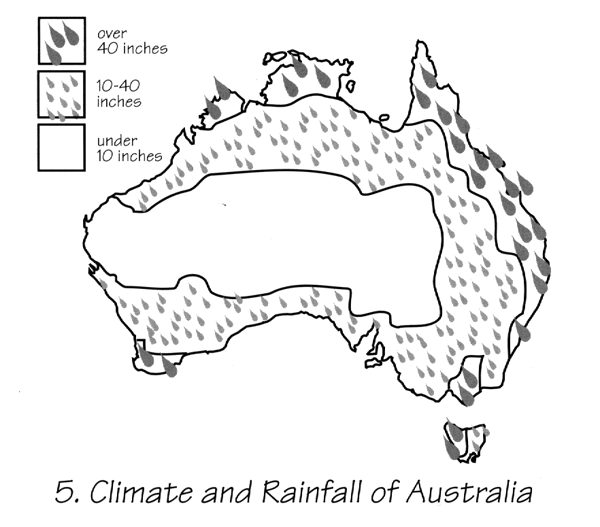
The climate of Australia varies because of its large size (see map 5). Generally, it is warmer and drier than the United States. Most of the continent receives only five to 20 inches of rain per year. The most steady rainfall occurs on the east coast near the Great Dividing Range and in the southwest corner of the country. Parts of the northeast, which include the tropical rainforests, have seasonal rains of up to 60 inches per year.
Most summertime temperatures range between 700 and 900 in the cities (all temperatures are in Fahrenheit). Winter is mild in most of Australia. The warmest winter temperatures are in the northern portion of the country (500-800), which is closer to the Equator. The southern area is usually colder in winter (300-500). In Australia, going south means traveling to a cooler region.
TRAVELING
TO AUSTRALIA
Many Americans enjoy visiting Australia each year. Most fly across the Pacific Ocean from Los Angeles to Sydney. The distance is 7495 miles, and travelers cross both the equator and the international date line. There are three time zones in Australia. Not counting daylight saving time, the east coast of the United States is fifteen hours behind the east coast of Australia.
Fun Fact: Travel Time| On non-stop flights from Los Angeles to Sydney, the flying time is about 14 hours. On the trip over you "lose" a day due to the time change (leave LA on Saturday and arrive in Sydney on Monday), and on the way back you take off and land on the same day (usually only a few hours after you left). |
ENVIRONMENT
& CONSERVATIONAustralians are very aware of the need to protect their unique natural environment. Many people belong to conservation groups. The state and federal governments all have programs to control pollution and to support conservation.
Clean Up the World
One activity that involves many Australians is Clean Up Australia Day. Individuals and groups organize to clean up their neighborhoods. Participants collect thousand of tons of trash from waterways, parks, roadways, and other community areas. Ian Kiernan created Clean Up Australia Day. He is a solo yachtsman and the 1994 Australian of the Year. He was amazed at the garbage that he saw in the oceans when sailing around the world. He went home determined to do something about it. The United Nations soon helped him to make his project an international event. The third Clean Up the World event in 1995 involved communities in about 100 countries.
World Heritage Areas and National Parks
Australia currently has 11 World Heritage Areas, regions that the United Nations believes have outstanding natural or cultural values of world importance. All are also national parks.
Australia has more than 540 national parks and 3200 other nature conservation reserves.
Rare and Endangered Species
Australians have come to treasure their unique animals and plants. In recent years, they have taken steps to guard against endangering them. The federal and state governments have developed programs for habitat protection and restoration. They participate in captive breeding and release of endangered animals. The governments also aim to control predators and feral animals, such as foxes, cats, pigs, rabbits and dingoes. Since 1989 there has been a national Endangered Species Program to fund and coordinate these efforts.
State and territory governments now have programs to gather information about rare and endangered species and their habitats, monitor their conservation status, and actively work for their preservation. One result is that new species are being discovered. They are mostly plants and insects. Every now and then, scientists find species that they thought were extinct.
Unfortunately, some species became extinct or endangered before people became concerned. The two main causes have been human settlement and changes in the natural environment. Australia had dinosaurs, but like those in other countries, they died out 65 million years ago. Around ten thousand years ago, Aborigines may have contributed to the extinction of a series of giant marsupial species through hunting and their use of fire. They included giant kangaroos, large wombats, and even a marsupial lion.
European settlement has caused more recent extinctions and threats. The habitats of plants and animals were lost when people cleared land for farms and towns. An animal that probably became extinct in the early 20th century was the Tasmanian tiger, or thylacine. This dog-sized marsupial had disappeared from the mainland, but still survived in Tasmania. Farmers hunted it because it attacked sheep. There is a stuffed specimen of this species in New York's Natural History Museum.
Some of the many Australian species that are currently threatened or endangered are listed below:
People sometimes report that Australia's popular cuddly symbol, the koala, is endangered. It is more correctly labeled "vulnerable." If people are not careful, it may become endangered. Hunters stopped taking koalas for their skins in the 1920s, but disease still makes them sick. They may become endangered in the future if people continue to clear eucalyptus forests, their main habitat and food source.
Large mainland kangaroos are no longer in danger of extinction, although some farmers raise them for meat and hides. There are more kangaroos now in Australia than when Europeans first arrived. These marsupials benefit greatly from irrigation and farmers' control of predators.
Fun Fact: No Longer In-Danger
In 1995 the US Fist and Wildlife Service removed the red, eastern and gray kangaroos from the endangered species list. |
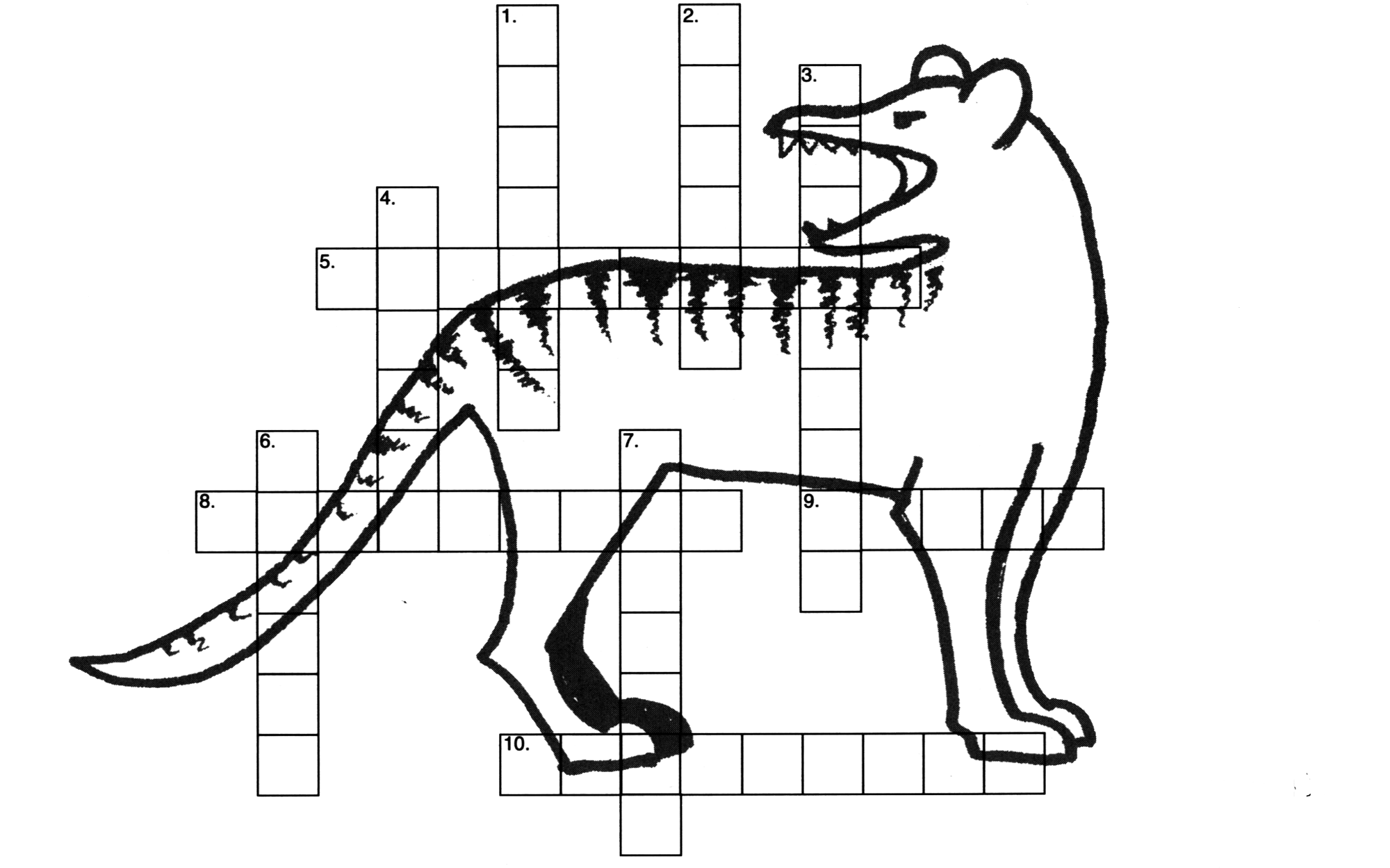
Down
1. The Tasmanian tiger is now believed to be_____.
2. A popular Australian marsupial that is found only in Queensland is the north-
ern hairy nosed _____.
3. Another name for the Tasmanian tiger is the _____.
4. Many species of Australian animals are endangered because they were _____
for their skins.
6. The Norfolk Island_____is an endangered Australian bird.
7. The northern ______ mouse is an endangered marsupial.
Across
5. The koala is considered to be ____, not endangered.
8. The pig footed _____ is an endangered marsupial.
9. The _____ parrot is an endangered Australian bird.
10. Red and gray _____ are now more numerous than they were at the time of
European settlement.
(Answers are at the bottom of the page)
SOME NATURAL
WONDERS AND FAMOUS LANDMARKS
Australia has some of the most interesting natural wonders in the world. Visitors to Australia are willing to travel long distances to see them. They also enjoy looking at some of the country's famous landmarks.
Great Barrier Reef
The Great Barrier Reef is the largest area of coral reefs and islands in the world. It stretches for about 1250 miles off the northeastern coast of Australia (see map 2). Its total area is more than 80,000 square miles.
Marine animals, called polyps, form the beautiful coral structures from calcium carbonate in the sea water. They build it around themselves to make a stony tube in which to live. They cement the tubes together as the colony grows. The different species of polyps and the water conditions determine the various shapes of the colonies. There are about 400 species of coral in the Great Barrier Reef.
The Great Barrier Reef is home to many other types of sea life, including sea anemones and jellyfish. About 1500 species of tropical fish swim in its waters, and 40 species of seabirds fly over its islands.
The United Nations has chosen the Great Barrier Reef as a World Heritage Area because of its complex and diverse habitat. The Australian government has set up programs to protect the reef. It tries to balance competing uses, such as conservation, tourism, shipping and agriculture.
Uluru
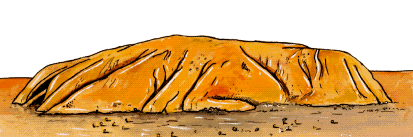
Uluru (pronounced oo-loo-Roo), formerly known as Ayer's Rock, is the world's largest rock. It juts 1140 feet from the surrounding plains and measures more than five miles around the base. Uluru is located in a remote desert region in the Northern Territory. It is the eroded summit of a buried sandstone hill, which extends deep into the earth. The rock appears to change color throughout the day - from pink to red to brown to blue to violet and back again. The caves, boulders and cliffs of Uluru and smaller domes nearby play an important role in the legends of local Aborigines, Australia's first settlers.
Sydney Opera House
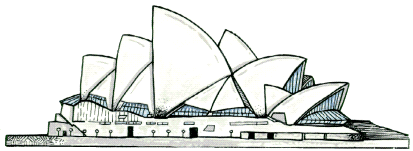
The Sydney Opera House is Australia's best known performing arts complex. Some of the country's best opera, theater and dance companies have performed there. Choirs, symphonies and bands also play at the Opera House. It was constructed between 1959 and 1973. The Opera House was one of the first large-scale construction projects designed using computers. It juts out into Sydney Harbour with the city as a backdrop. Some people think that the Opera House looks like three sailing ships setting out to sea. The two larger "ships" contain the Concert House (seating 2700), the Opera Theatre (seating 1550) and a number of cafés and smaller theaters. The smallest "ship" has a restaurant. There are nearly 1000 rooms in all.
Fun Fact: Support Structures
More than 2000 precast concrete segements, like ribs, support the structure of the Sydney Opera House. The roof sections are covered with a million tiles |
Sydney Harbour Bridge
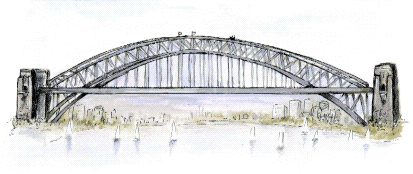
The Sydney Harbour Bridge carries traffic between Sydney's north shore and the downtown area and eastern and southern suburbs. Before it opened in 1932, commuters traveled across the harbor by ferry. The design of the bridge was an engineering achievement for its time. It remains wider and heavier than any other arch bridge in the world. The main span is about 1658 feet long. The crown of the arch is 445 feet above sea level. People affectionately call it the Coat Hanger because of its appearance. In 1992, a vehicular tunnel was opened under the 8-lane bridge to help with traffic.
Parliament House
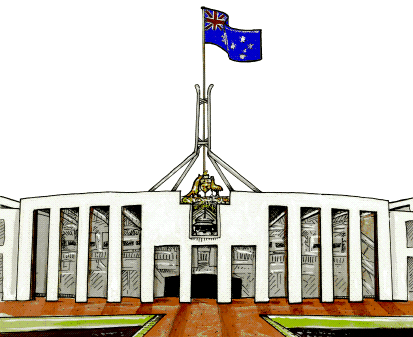
Parliament House is the building where Australia's federal legislature meets. It sits in the summit of a low hill in Canberra, the nation's capital. The building was opened in 1988. It covers an area of 989 square feet. From the air, it looks like two boomerangs meeting in their centers
Parliament House has beautiful marble and timber interiors made mostly from Australian materials. The building's most prominent feature is a flagpole 267 feet high, sitting squarely on top. The flag, about 42 feet by 21 feet, flies around the clock. People can see it for miles. Most of the grass-covered roofline of the building slopes downward. The public can stroll over it. From the top, visitors can look out over Lake Burley Griffin, the downtown area and the Brindabella Mountains.
Answers to crossword
Down
1) extinct
2) wombat
3) thylacine
4) hunted
6) parrot
7) hopping
Across
5) vulnerable
8) bandicoot
9) night
10) kangaroos