 Tell Me About:
  Tell Me About:
 Many animal species are native only to Australia. The country is known for its unusual mammals, called monotremes and marsupials. The monotremes include only the platypus and the echidna. Animals such as the kangaroo, koala and Tasmanian devil are marsupials. All mammals have fur or hair and suckle their young with milk from mammary glands.
Mammals |
||
Monotremes |
Marsupials |
Placentals |
Young hatch from an egg
Examples: (only two) Echidna |
Young are born at an immature stage and grow inside the mother's pouch, called a marsupium
Examples: Kangaroo |
Young are born at an advanced stage of development
Examples: |
We also mention other species of animals found in Australia such as unique birds, insects, spiders, reptiles and sharks
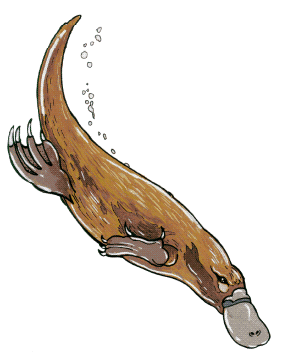
Monotremes, or egg-laying mammals, are the most primitive group of mammals. Monotremes are more closely related than other mammals to reptiles. After the young hatch from eggs, they are fed milk through pores in the mother's skin. Australia and the neighboring island of New Guinea are the only places mono-tremes live. There are only two members of this mammal group, the echidna and the platypus. When the first platypus specimen was taken to Great Britain, it was so unusual that many scientists thought it was a hoax.
Platypus Distinguishing features:
|
Other information:
|
| Food: insects, worms, tadpoles and crustacea | Region: southern mainland and Tasmania |
| Habitat: burrows its nest into the banks of rivers and creeks |
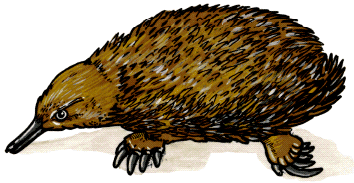 Echidna
 Distinguishing features:
|
Other information:
|
| Food: insects (ants and termites) | Region: throughout Australia |
| Habitat: hollow logs or piles of debris |
 Fun Fact: Survival Skills
The echidna can survive without food for up to a month |
The most famous Australian mammals are marsupials or pouched mannals. Their young are very immature at birth. They must crawl into the mother's pouch, formed by a fold of skin over the mammary glands. There they nurse and develop until they are able to live on their own. Koalas and kangaroos (including wallabies) are the world's best know marsupials.
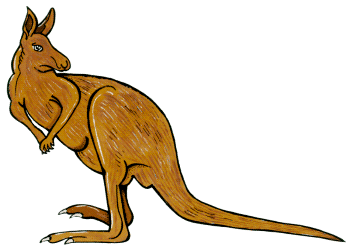 Kangaroo
Distinguishing features:
|
Other information:
|
Food:
|
Region: throughout Australia |
| Habitat: open forests and plains |
Fun Fact: National Animal?Australian's commonly consider the kangaroo their national animal. It appears on the national coat of arms. |
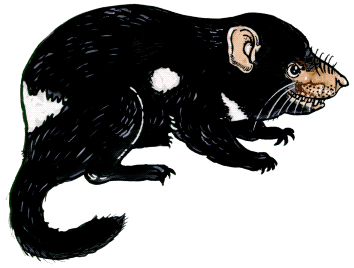 Tasmanian Devil
Distinguishing features:
|
Other information:
|
| Food: rotting flesh, small birds and animals, and insects | Region: extinct from the mainland; now found only in Tasmania |
Habitat:
|
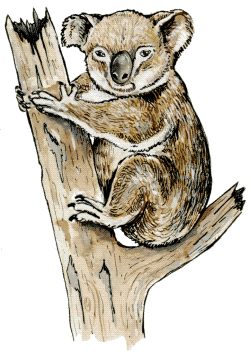 Koala
KoalaDistinguishing features:
|
Other information:
|
Food:
|
Region: southeastern Australia |
| Habitat: mainly arboreal (living in trees) |
Fun Fact: How thirsty are you??Koala means "no drink" in one Aboriginal language. |
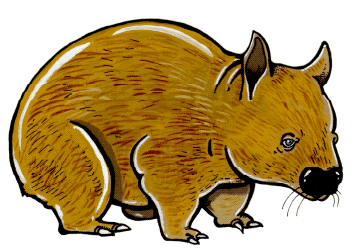
Wombat
Distinguishing features:
|
Other information:
|
| Food: grasses, roots, vegetables and leaves | Region: Tasmania and southern mainland |
| Habitat: burrows along tree roots and rocks |
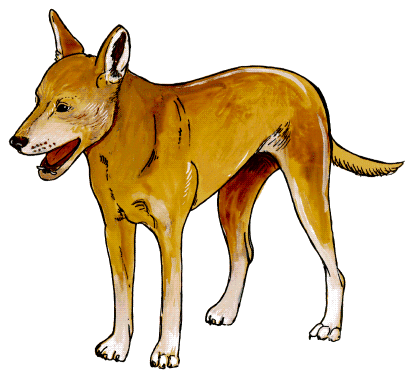 The most common type of mammal worldwide is
the placental mammal. Unborn young grow inside the mother, attached to her
by an umbilical cord and placenta. They are born alive, rather than as eggs.
Few placental animals are native to Australia. The dingo, a species of wild
dog, came from Asia thousands of years ago with the Aborigines. Later immigrants
brought other placental mammals to Australia.
The most common type of mammal worldwide is
the placental mammal. Unborn young grow inside the mother, attached to her
by an umbilical cord and placenta. They are born alive, rather than as eggs.
Few placental animals are native to Australia. The dingo, a species of wild
dog, came from Asia thousands of years ago with the Aborigines. Later immigrants
brought other placental mammals to Australia.
Australian birds include colorful parrots, magpies, pelicans, boobook owls, and brolgas (cranes). Descriptions of the emu, lyrebird and kookaburra are below.
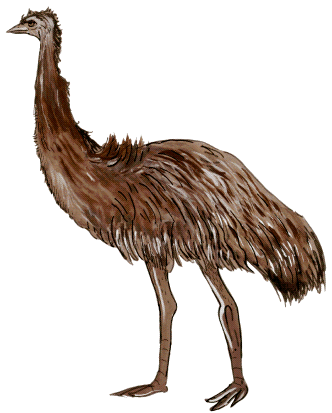 Emu
Emu
Distinguishing features:
|
Other information:
|
| Food: pasture grasses, seeds, fruit, and insects | Region: formerly inhabited the whole of Australia; now extinct in Tasmania |
| Habitat: open grasslands, semi-desert, scrublands and woodland refuges |
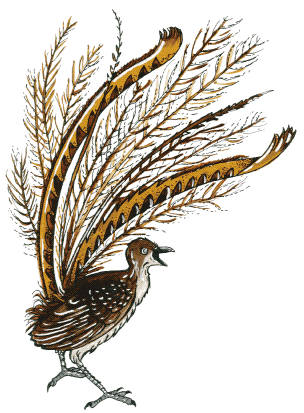 Lyrebird
Distinguishing features:
|
Other information:
|
| Food: earthworms, snails, beetle larvae, centipedes | Region: southeastern Queensland to Victoria |
Habitat:
|
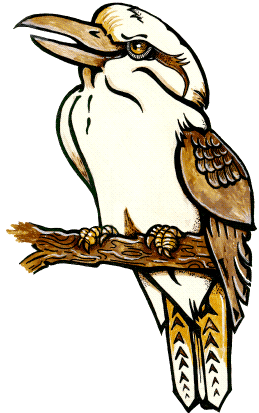 Kookaburra
Distinguishing features:
|
Other information:
|
Food:
|
Region: eastern mainland Australia |
Habitat:
|
There are about 80,000 species of insects in Australia. One of the most interesting is the large termite, found in the north. It is about the size of a big cockroach. Colonies of large termites build rock-like nests up to 20 feet high.
Mosquitoes are found in Australian tropical regions. Australians call them mozzies. They can be a nuisance along coastal waterways, especially at dusk in the summer. Some carry diseases such as malaria, but this is uncommon in Australia.
Blowflies breed in sheep and horse manure, cattle dung and pig waste products. Introduction of these animals has allowed the blowfly population to increase since ancient times. They thrive near animal grazing pastures.
Australia also has numerous cockroach species. Large (2") cockroaches are native to the sub-tropical and tropical regions of Australia. International shipping introduced smaller species. These now reside in most cities.
Australia has about 2000 recognized species of spiders. The most dangerous
are the redback and the funnelweb. The funnelweb is among the most venomous
spiders in the world. It has been responsi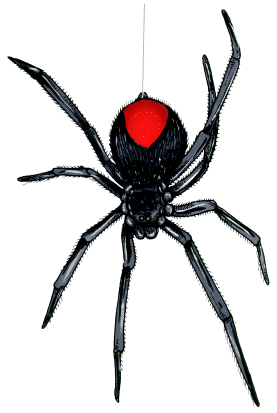 ble for a number
of human deaths. An antivenene is available, but it must be given quickly.
ble for a number
of human deaths. An antivenene is available, but it must be given quickly.
The redback spider's abdomen is marked with different colors, but mostly red, in the shape of an hourglass. Although some humans have died from its bite, an effective antivenene is available.
Australia also has many species of reptiles, including lizards, snakes and crocodiles. Some can be dangerous to humans, but the vast majority are harmless.
Lizards
The go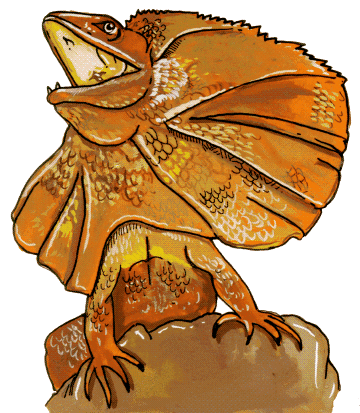 anna, a monitor lizard, ranges in size
from 18 inches to 6 feet. It has short legs with sharp claws and a long,
forked tounge that it flicks in and out. Some species are arboreal (tree-dwelling).
There is an Aboriginal story about their beautifully patterned skin.
anna, a monitor lizard, ranges in size
from 18 inches to 6 feet. It has short legs with sharp claws and a long,
forked tounge that it flicks in and out. Some species are arboreal (tree-dwelling).
There is an Aboriginal story about their beautifully patterned skin.
The frill-necked lizard is a type of dragon lizard. It has an unusual frilly collar of skin that stands out around its neck when it is angry or frightened. It if cannot scare off potential enemies, it runs away at high speed on its long, hind legs.
Snakes
Australia has about 160 species of snakes. Some are among the most dangerous
to humans. In fact, Australia is the only continent in which venomous species
outnumber harmless ones. They include death-adders, copperheads, tiger snakes
and red-bellied black snakes. One of the deadliest is the taipan, which
lives in the northern part of the country. It may grow to 10 feet long.
Its close relative, the brown snake, has the most toxic venom of any Australian
species. Venom c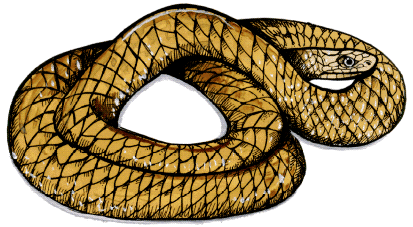 an either destroy the linings of blood
vessels, cause blood to clot, or destroy red blood cells. It can also cause
death by blocking the nerves that control the heart and lungs.
an either destroy the linings of blood
vessels, cause blood to clot, or destroy red blood cells. It can also cause
death by blocking the nerves that control the heart and lungs.
Many Australian snakes however, are harmless to humans. One is the carpet snake, or common python, patterned with black and brown. Another is the diamond back snake, greenish-black with yellow diamond-shaped markings. Pythons are non-venomous and kill their small prey by squeezing them until they cannot breathe. The largest is the rock python. The longest Australian python ever recorded was 23 feet.
Crocodiles
There are two species of crocodile in Australia: the estuarine, or saltwater,
crocodile and the freshwater crocodile. Both are found only in tropical
waters. Freshwater crocodiles are found only in billabong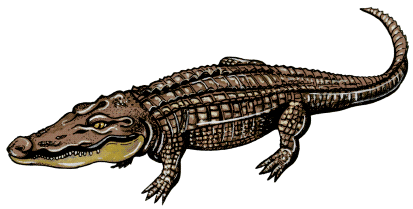 s and lagoons.
They range from the Gulf of Carpentaria to northwestern Western Australia.
They are harmless to humans, feeding only on small prey. They are rarely
longer than nine feet.
s and lagoons.
They range from the Gulf of Carpentaria to northwestern Western Australia.
They are harmless to humans, feeding only on small prey. They are rarely
longer than nine feet.
The estuarine crocodile makes its home both in estuaries and upstream in large coastal rivers. It lives in all of northern Australia. These crocodiles feed mainly on small aquatic animals such as fish, crabs and water rats. They sometimes turn to larger prey such as cattle, horses or humans. They generally seize and drown their prey before eating it. The estuarine crocodile can reach a length of 23 feet and weigh 2200 pounds.
Sharks are found all around Australia's coastline. They have changed
little in the last 200 million years. The bronze whaler and the common,
or gray, whaler are large and dangerous sharks patrolling much of eastern
Australia. The gray nurse, a relatively sluggish shark, preys on Australian
s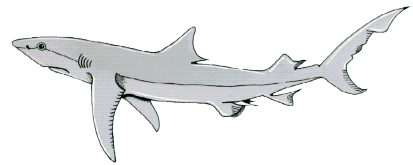 almon and other fish. People often blame it for
trying to eat swimmers and divers. The gray whaler actually makes these
attacks. The tiger shark is dark gray with darker stripes and blotches.
It lives in tropical and sub-tropical waters.
almon and other fish. People often blame it for
trying to eat swimmers and divers. The gray whaler actually makes these
attacks. The tiger shark is dark gray with darker stripes and blotches.
It lives in tropical and sub-tropical waters.
The white pointer, also called the great white shark or white death, can be almost 40 feet long. It is perhaps the most dangerous shark of all. It is common in waters off southern Australia in summer and off Queensland in winter.
Fun Fact: Jaws in Oz?The actual number of Australian shark fatalities in more than 150 years averages fewer than one per year. Almost all incidents take place in the summer |
 BIRDS
BIRDS